
How global brands are turning vending machines into immersive retail moments and what it means for India’s fast-growing D2C sector.
Snack dispensers? Not really.
The vending machine’s story begins not in a convenience store, but in ancient Greece. In 215BC, mathematician Hero designed a coin-operated holy-water dispenser, the world’s first automated retail unit. What followed over two millennia is a saga of creativity and convenience: postcards in 1883, cigarettes in 1926, hot beverages in the 1950s, and today, luxury perfume trials, AR photo booths, and AI-powered personalisation engines housed in a single kiosk.
The evolution has been, as the category deserves to be called, extraordinary.
Today, as India’s D2C brands race to expand offline, grappling with real estate costs, inventory complexity, and the pressure to deliver premium experiences in Tier 2 and Tier 3 cities. The smart vending machine is not a future possibility – it is one of the most compelling answers to a very real problem.
The Market Opportunity
The global smart and interactive vending machine market is projected to reach USD 92.64 billion by 2034, growing at a CAGR of 13.79%, one of the fastest-growing segments in modern retail. The smart interactive segment alone is estimated at USD 53.2 billion by 2036, driven by AI personalisation, real-time inventory tracking, and contactless commerce.(Ref )
USD 92.64B projected global smart vending market by 2034
13.79% CAGR, one of retail’s fastest-growing segments
71% of vending transactions in 2024 were cashless
5.2B+ global air passengers annually, representing the airport retail opportunity
For Indian brands specifically, this timing matters. The country’s D2C sector is scaling rapidly, but the cost and complexity of physical retail expansion remains a genuine constraint, particularly for brands built online, now looking to meet customers where they shop in person.
What Makes a Vending Machine Campaign Extraordinary?
Smart vending machine campaigns become memorable when they are designed around interaction, experience, and engagement, not just transaction. Four elements consistently separate campaigns that generate ROI and social buzz from those that simply dispense products:
1. Distinctive Design
The machine must be a visual centrepiece, not a background utility. Benefit Cosmetics’ signature bright-pink beauty truck vending kiosk is a textbook example. It commands attention, communicates brand personality, and draws footfall before a single product is dispensed.
For Indian D2C brands, this is particularly relevant: in a crowded mall or airport terminal, design is the first and most powerful differentiator.
2. Immersive Interaction
Touchscreens, gamification, loyalty rewards, and personalised recommendations turn a transaction into an experience. GoGo Squeeze’s ‘Goodness Machine’ launched apple-sauce pouches into the air for kids to catch. Simple, memorable, wildly shareable. The goal is to make customers engage, not just purchase.
3. Location Strategy
Placement in high-footfall areas can increase ROI possibilities by 35–50%. Airports, malls, transit hubs, and co-working clusters are not just convenient. They are environments where consumers are primed for discovery purchases, especially in the beauty, personal care, and consumer electronics categories.
4. Social Shareability
The best campaigns turn purchases into user-generated content. When a moment is designed to be shared, the machine becomes a media channel, amplifying reach far beyond the physical location. Moët & Chandon’s AR photo booth champagne vending machine, which enabled guests to create and share AR-enabled e-cards, is a benchmark in this space.
Case Study 1: Luxury and Fashion: Vending as Brand Experience
Luxury brands have been among the earliest and most inventive adopters of creative vending, using machines not to commoditise their products but to create exclusive, brand-consistent moments in unexpected places.
UNIQLO: AIRPORT ESSENTIALS
Uniqlo deployed smart vending machines in airports offering limited-edition warm vests, using touchscreens for quick sizing and checkout. The insight was precise: travellers have a genuine need, limited time, and a willingness to pay for convenience. The result was a retail moment that felt premium, not impulsive.
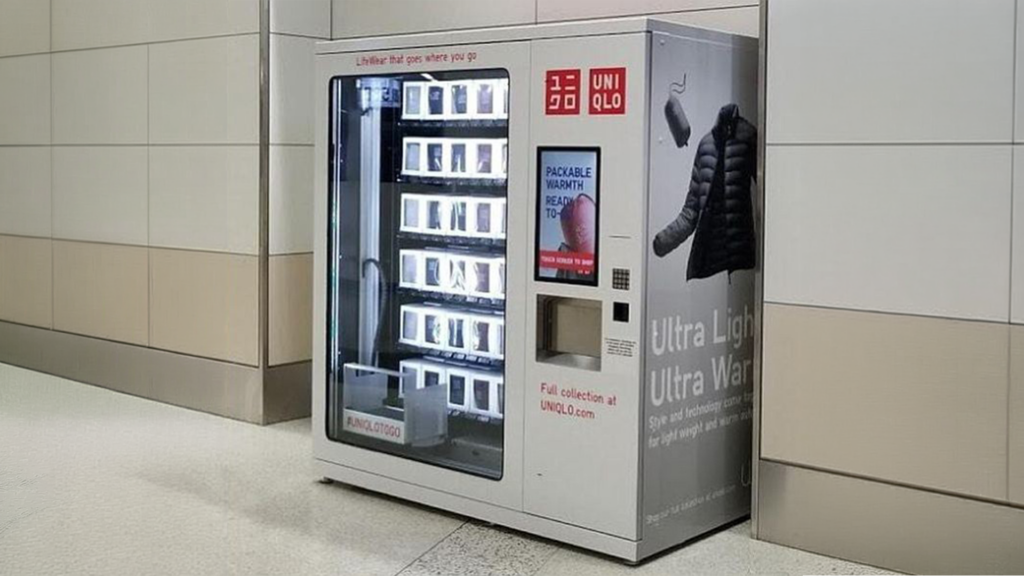
Source : Uniqlo’s Vending Machines
HERMÈS: HERMÈSMATIC
For the 80th anniversary of its iconic silk scarves, Hermès launched a travelling pop-up in LA, Paris, New York, and Kyoto, allowing customers to re-dye their scarves free of charge. This wasn’t retail; it was brand theatre. The machine became the experience, creating emotional memory around the product.
ADIDAS: HYPE DROP EXCLUSIVITY
Adidas used custom vending at high-energy events for rare sneaker drops, incorporating facial recognition and token systems to manufacture exclusivity. The scarcity mechanism drove queues, social content, and genuine brand desire.
For premium D2C brands in India, navigating the balance between exclusivity and accessibility, these luxury plays offer a direct playbook: use the machine to amplify the brand story, not just move product.
Case Study 2: Beauty and Skincare, Sampling, Personalisation, and Impulse
The beauty and personal care category is, arguably, where smart vending machines have demonstrated the most sophisticated executions. The combination of product trial, personalisation, and impulse purchase mechanics makes it a natural fit, and the global results speak for themselves.
LANCÔME: MULTI-SENSORY PERFUME TRIALS IN SINGAPORE
Lancôme’s Idôle pop-up vending in Singapore used multi-sensory sample dispensers to drive discovery for its fragrance range, a brand valued at USD 6.2 billion. The machine didn’t replace the beauty counter; it extended it into locations and hours a counter cannot occupy.
YSL: PERSONALISED LIPSTICK VENDING IN HONG KONG
YSL’s lipstick vending machine in Hong Kong allowed customers to engrave names and match shades through a touchscreen quiz, turning a trial into a personalised keepsake. The machine created an emotional attachment to the product before it was even purchased.
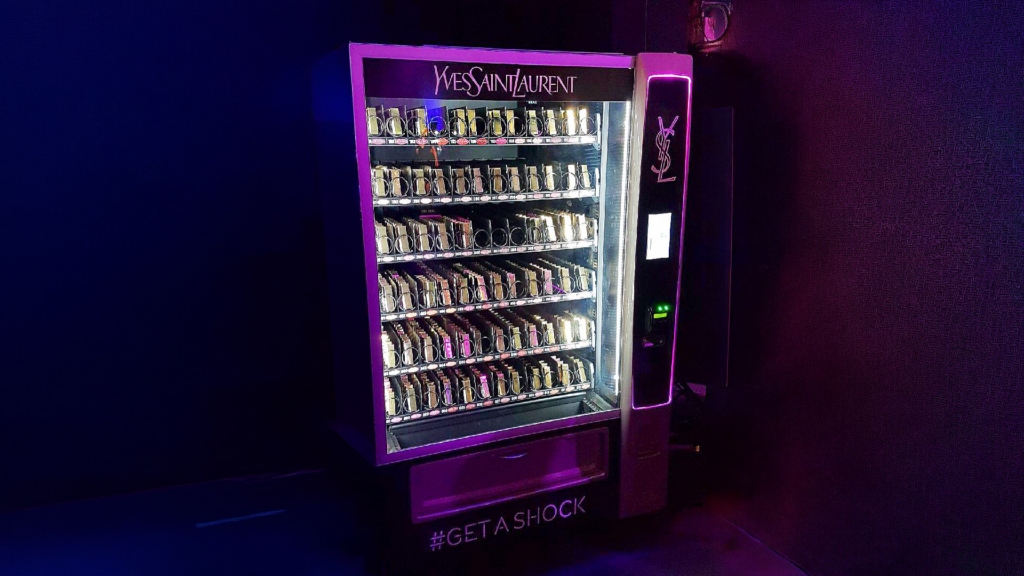
Source : Yves Saint Laurent Beauty
BENEFIT COSMETICS: ‘GLAM UP & AWAY’ AT AIRPORTS
Benefit Cosmetics introduced its signature kiosks at major international airports, offering quick beauty fixes for travellers. The combination of high footfall, time-pressured consumers, and a premium but accessible product range made it a near-perfect retail environment.
For Indian beauty and personal care brands expanding beyond metros, these models are directly transferable, not as aspirational foreign concepts, but as proven templates for reaching consumers in Tier 2 cities without the overhead of a full retail store.
The economics are worth considering: a smart vending machine can operate in a mall corridor, an airport terminal, or a co-working hub with significantly lower operational overhead than a staffed retail counter, while offering 24/7 availability and real-time sales data.
Case Study 3: Travel Retail: The Airport Opportunity
With global air passenger traffic expected to exceed 5.2 billion in 2026, airports represent one of the most concentrated retail opportunities on the planet, with high dwell time, diverse demographics, and consumers already in a purchase mindset.
OPTIC TO GO: EYEWEAR VENDING
Optic to Go’s eyewear machines in airport terminals demonstrated that even considered, higher-value purchases can work in automated retail, provided the experience is designed for the environment. Quick sizing, clear product display, and frictionless checkout turned a category that previously required assisted selling into a self-service success.
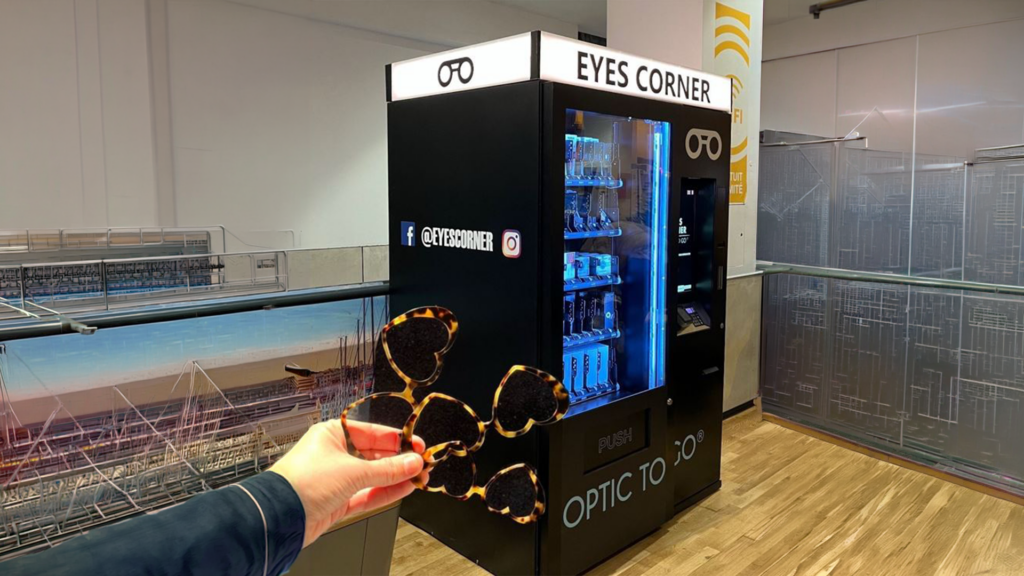
Source : Optical Vending Machines
HUDA BEAUTY: TRAVEL RETAIL EXPANSION
Huda Beauty’s airport vending presence showed how digitally-native beauty brands can use smart retail to establish physical credibility in premium travel environments, reaching consumers who may not have encountered the brand in traditional retail.
For Indian consumer electronics brands like those in the boAt or Noise tier, which have a strong online presence and seek offline credibility, the airport vending model is particularly worth studying. High-footfall, tech-savvy, impulse-receptive consumers are already there. The question is how to meet them with an experience worthy of the brand.
Case Study 4: Smart Interactive Machines: Technology as the Experience
The most sophisticated executions in creative vending don’t just sell products through a machine. They make the machine itself the product experience.
COCA-COLA FREESTYLE: PERSONALISED BEVERAGES AT SCALE
Coca-Cola’s FreeStyle touchscreen machines allow customers to mix over 100 custom drink combinations, deployed in stadiums and airports worldwide. The machine turned a commodity beverage into a personalised ritual and generated data on consumer preference that informed product development.
The technology enabling these experiences is now accessible and proven:
- AI-powered product recommendations that increase sales by 20–30%
- Touchscreen interfaces with digital catalogues that increase dwell time by approximately 35%
- Contactless payment systems, with 71% of 2024 vending transactions cashless
- Data-driven inventory management that can reduce product waste by up to 22%
For brands managing multiple SKUs across geographies, a real challenge for growing Indian D2C companies, this data layer is as valuable as the sales themselves. Real-time visibility into what sells where, at what time, enables smarter restocking, more targeted marketing, and faster decision-making.
How to Plan a Winning Vending Machine Campaign
Across every successful execution reviewed, six consistent steps emerge:
- Ideation: Design the interaction around your brand story, not just the product. What emotion should the machine create?
- Design: The machine must demand attention. Invest in aesthetics as you would any brand touchpoint.
- Location: High-footfall, high-intent environments like airports, premium malls, and transit hubs consistently outperform.
- Technology: Touchscreens, personalized recommendations, virtual try-ons and contactless payments are now table stakes, not differentiators.
- Launch: Seed the activation with influencers and create a shareable moment to generate earned media from day one.
- Measurement: Track sales uplift, dwell time, and repeat engagement. The machine generates data, so use it.
The India Opportunity: Why This Moment Matters
Every brand referenced in this piece solved a version of the same problem: how to reach more customers, in more places, without diluting the brand or destroying the margin.
That is precisely the challenge facing India’s D2C brands today.
The traditional retail expansion playbook, with high real estate costs, staffing overheads, and long lead times, is increasingly unworkable for brands built on the economics of online commerce. At the same time, consumer expectations are evolving rapidly. Shoppers in Tier 2 cities expect the same quality of brand experience as those in Mumbai or Delhi. Omnichannel is no longer a premium add-on; it is the baseline.
Smart vending machines offer a credible path through this challenge: a compact, automated, brand-consistent retail presence that can be deployed in the right locations at a fraction of traditional retail cost, with the data infrastructure to prove ROI.
The global case for smart vending in beauty, personal care, and consumer electronics is no longer theoretical. The Indian D2C opportunity is waiting.
OgmentO builds smart vending and automated retail solutions for D2C brands in India. If you are exploring how to expand your physical presence without traditional retail overhead, we’d like to show you what’s possible. Connect with us at hello@ogmento.io to explore our automated retail solutions.