
‘Expect to lose a customer when the only thing growing faster than their appetite is the queue at the restaurant counter.’
Whether it’s a busy lunch break, a quick coffee run, or a family dinner, customers expect quick, simple, and hassle-free ordering, not to wait indefinitely in queues to get to the counter. The longer the wait, the lower the customer experience.
Restaurants are thus responding to these CX urgencies by embracing digital solutions, such as self-ordering kiosks, which have quickly become one of the most effective additions to modern quick-servicedining spaces.
By allowing customers to place orders independently with custom ordering and cashless payments, these kiosks reduce wait times, improve order accuracy, and create a smoother dining experience from start to finish.
More importantly, they help restaurants serve more customers without placing additional pressure on staff. It’s a win for diners, restaurant teams, and business owners alike.
What Is A Self-Ordering Kiosk?
A self-ordering kiosk is a touchscreen system that enables customers to browse a restaurant’s digital menu, customize meals, place orders, and complete payments without assistance from the counter staff.
Designed to simplify the ordering process, these kiosks present clear menu categories, high-quality product images, pricing, and customization options in one easy-to-use interface. Once an order is placed, it is sent directly to the kitchen, reducing manual intervention and minimizing communication errors.
Why Restaurants Are Adopting Self-Ordering Kiosks
‘Restaurants serve meals. Queues serve life lessons. Customers generally prefer the former’
Restaurant owners aren’t just adopting kiosks because they look high-tech; they’re doing it because traditional dining workflows are hitting a wall.
- Rising Demand for Speed: Modern diners, conditioned by instant apps, expect their food without the wait.
- Reduced Dependency on Staff: Labour shortages and rising operational costs mean restaurants must do more with leaner teams.
- Peak-Hour Performance: Instead of bottlenecking at a single register, restaurants can process dozens of orders simultaneously.
- Operational Efficiency: When orders flow directly to the kitchen without manual re-entry, the whole engine runs smoother.
- A Better Overall Dining Experience: Less stress for the staff means better service, and faster food for the customer means a happier meal.
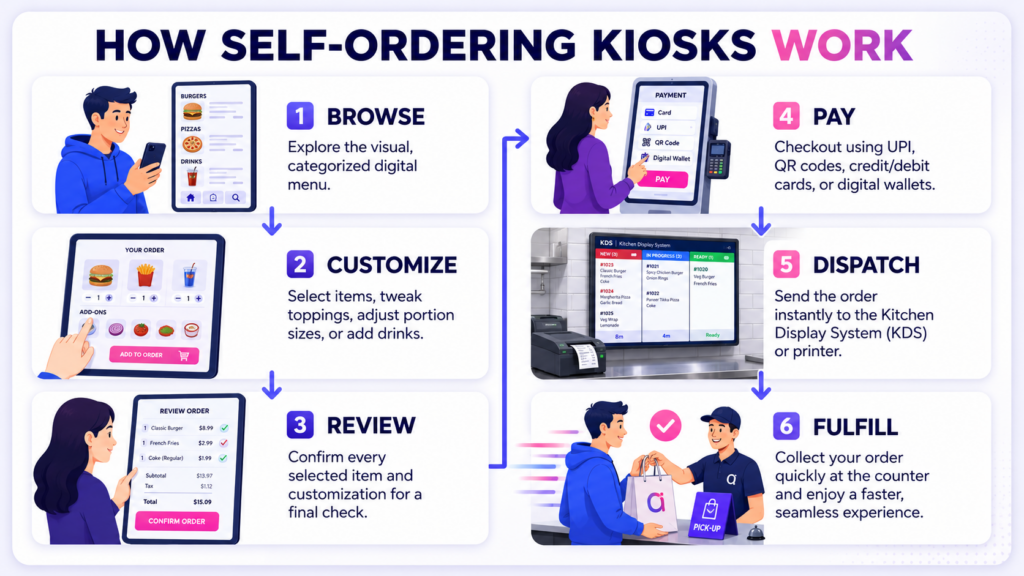
How Self-Ordering Kiosks Work
The ordering journey is simple and intuitive.The user flow takes less than a minute.
Ways Self-Ordering Kiosks Upgrade Customer Experience
Here is how self-ordering kiosks take the friction out of your meal and give the dining experience a major upgrade:
- Bypass the Bottleneck: Self-ordering kiosks enable diners to skip counter congestion at peak times and place orders quickly, customise smoothly and pay effortlessly,all in seconds. This leads to faster order processing, reduced crowding, smoother customer flow, and a more organized dining environment.
- No More Waiting: Because multiple kiosks process orders simultaneously, counter lines melt away and floor traffic keeps moving smoothly even during the peak rush.
- Menus You Can Actually See: High-res food photos and intuitive categories beat smudged, laminated paper menus or tiny chalkboard handwriting every single time. You get to see exactly what you’re ordering.
- Judgment-Free Customization: Double cheese, extra sauce, extra fries, light ice, or zero pickles,self-ordering kiosks allow detailed customizations with a few quick taps, without the need to over-explain a complex order out loud.
- Low-Touch Hygiene: Self-ordering kiosks allow seamless, low-friction transactions that give you full control while keeping personal interaction minimal and hassle-free.
- What You Tap Is What You Get: Since orders are entered by customers themselves, nothing gets misheard or lost in translation. Order accuracy goes way up.
- Seamless Checkout: Cards, QR codes or digital wallets- kiosks allow payments in seconds, followed by a direct and accurate intimation to the kitchen.
Benefits For Restaurant Owners
While customers enjoy greater convenience, restaurant owners benefit from improved operational efficiency.
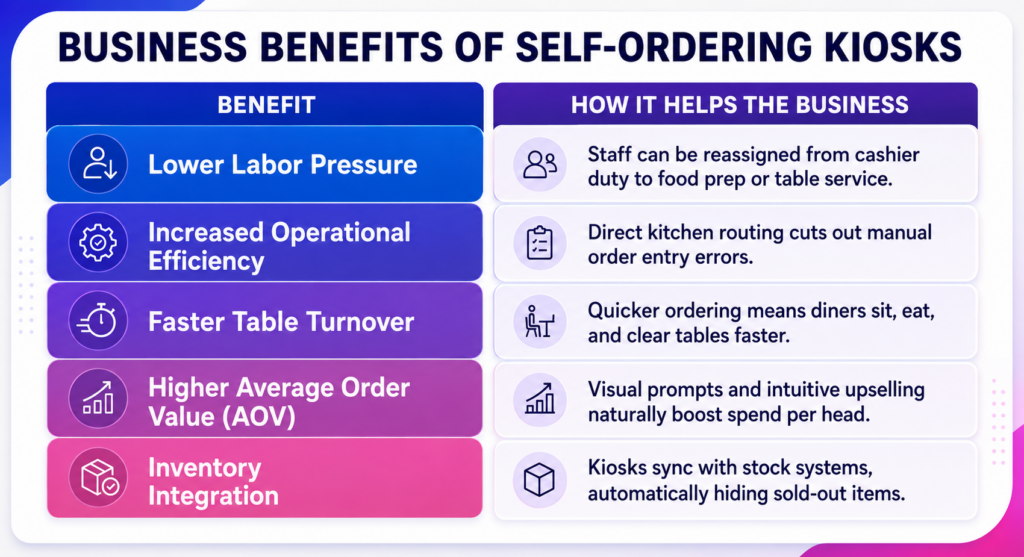
Ultimately, the result of improved efficiency is higher sales potential and happier customers that return for more.
Where Self-Ordering Kiosks Are Used
Self-ordering technology isn’t limited to traditional fast-food joints. It is transforming a wide variety of food service formats:
- Quick Service Restaurants (QSRs): For ultra-fast order placement and rapid turnover.
- Fast Food Chains: Streamlining high-volume customer traffic.
- Cafés: Allowing customers to precisely customize complex beverage orders.
- Food Courts: Reducing cross-counter confusion in busy shopping centres.
- Casual Dining Restaurants: Enabling order-at-table or front-of-house entry.
- Cinema Food Counters: Keeping concession lines moving before the movie starts.
Why Choose OgmentO
At OgmentO, we help restaurants embrace smarter and more efficient ordering experiences through advanced self-ordering kiosk solutions.
Suitable for growing cafés, busy QSRs, multi-location restaurant chains and more, OgmentOkiosks are designed to simplify customer ordering, support secure digital payments, streamline restaurant operations, and improve overall service efficiency.
Touchscreen interfaces, seamless POS integration, customizable branding, and real-time management capabilities further enable restaurants to enhance customer satisfaction and operational efficiency.
Food For Thought – Why Kiosks Are Here To Stay
Great food may bring customers through the door, but a smooth ordering experience is often what keeps them coming back.
Self-ordering kiosks are quickly becoming essential tools for restaurants, especially QSRs. By delivering faster service, virtually eliminating order errors, reducing queue times, and making payments effortless, kiosks create a win-win environment for customers and owners alike, where customers enjoy a control-driven, hassle-free dining experience, while restaurant owners enjoy smoother operations and higher revenue.