
Stepping away from your desk for a quick snack, beverage, or lunch can boost productivity. Stepping out of the office perimeter for the same purpose, though? Not so much.
Taking a standard example, when 20 employees each spend fifty minutes a day leaving the office for food runs, the company loses about 4,000 hours of productivity every year.
This is not about the breaks. This is about the output efficiency lost by going back and forth between the office and outside cafeterias, factoring in traffic, wait times, and unsatisfactory, rushed meals.
The result? Lost productivity, low employee morale and a subsequent drop in performance.
This is why micro markets for corporate offices are now becoming the new norm. These 24/7, self-service, open-shelf, unmanned stores offer nutritious meals, snacks, and drinks, giving employees access to healthy options anytime, without leaving the office.
Let’s explore what makes micro-markets the right fit as food partners for corporate spaces.
What Is A Micro Market For Corporate Spaces
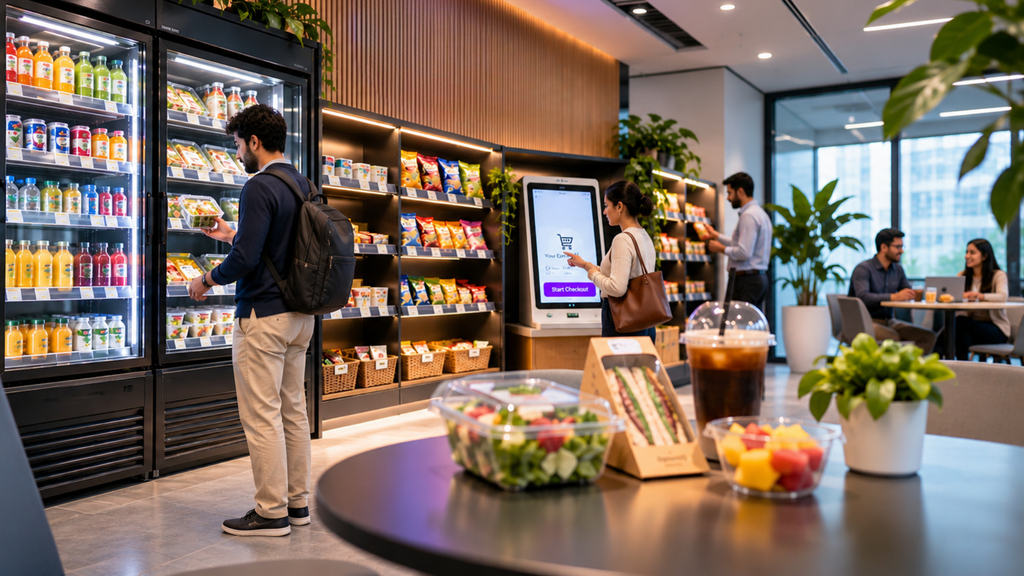
Typically, a 5,000 sqft to 8,000 sqft corporate space can comfortably accommodate a 50-person team, leaving enough room for a workplace micro market spanning as little as 100 sqft to 150 sqft+. Larger spaces with 100-person+ teams can accommodate larger micro markets.
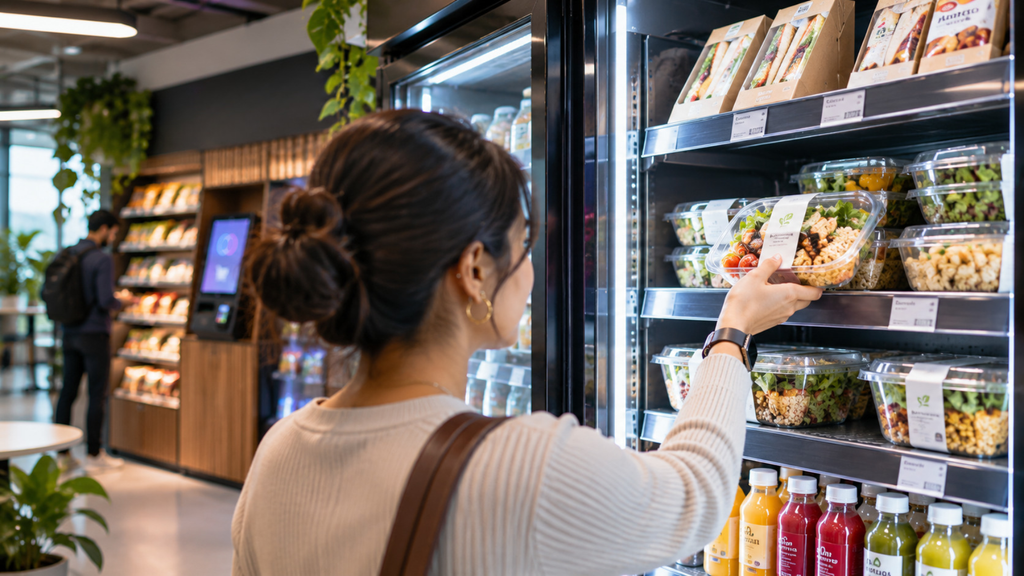
Micro markets for corporate spaces are temperature-regulated, open-shelf, self-service stores that primarily focus on fresh, nutritious meals like sandwiches, salads, rice bowls, beverages, etc.
Here, employees walk in, pick their meals, scan and check out at a self-service kiosk, and pay with contactless options like QR codes, UPI, cards, and wallets. No staff, no hassles, just quick 24/7 on-the-go snacks and meals with the added benefit of health.
Furthermore, tech integrations help operators monitor sales and stock levels in real time, identify popular products, and plan timely replenishments.
Why Do Offices Need Micro Markets?
If you need to keep employees energized round the clock, you need to bring a greater option of nutrition closer to them. That’s why micro markets are ideal for corporate offices.
These automated self-service, self-checkout retail layouts have numerous operational and experiential advantages that best fit for office premises, including –
- Employee convenience and time saving: Employees enjoy instant access to snacks and meals on-site, drastically cutting down on outside trips and long mid-day coffee runs.
- Wider and healthier choices: Micro markets can house a wide variety of customizable items, easily accommodating fresh meals and healthier dietary options.
- 24/7 access: Seamlessly supports night shifts, odd-hour schedules, and hybrid teams working outside standard operating windows.
- Culture and retention: Centralized break spots encourage organic peer connection, boosting workplace morale and employee retention.
- Cashless and hygienic: Transactions are mainly contactless and digital, ensuring a clean, friction-free retail experience.
- Zero cafeteria staff: Fully automated self-checkout counters eliminate the overhead costs and logistical hassle of managing dedicated kitchens or cafeteria personnel.
- Data-driven stocking: Real-time sales analytics track exact purchasing habits, automatically guiding future inventory choices to minimize waste.
Micro Market VS Vending Machine VS Cafeteria
Micro markets, vending machines, cafeterias – in any corporate space, you are likely to find one of these as key refreshment setups. Which you choose for your space depends upon available space, employee demand, the desired product range and the operating budget.
Here’s a quick chart to highlight the key characteristics of each –
| Factor | Vending machine | Micro market | Cafeteria |
| Selection | Limited, machine- dependent range | Wider choice across shelves and displays | Menu-based selection |
| Space | Small footprint | Medium to large, depending on layout | Large space, often with a kitchen |
| Cost | Generally lower setup requirements | Low to medium depending upon equipment and operating model | Often high due to staffing and infrastructure costs |
| Servicing | Restocking and maintenance | Stocking, inventory checks, cleaning and maintenance | Food preparation, staffing and daily operations |
| Availability | Can operate beyond office hours | Can offer extended or 24/7 access | Usually follows service hours |
Rule of Thumb? Use vending machines for small offices with restricted floor space or as an extension to existing cafeterias. Use micro markets for larger teams that require fresh options, variety, and open-flow convenience.
Which Offices Benefit From Micro Markets
Micro markets benefit corporate spaces that get roughly 100+ footfalls per day. The more, the better. These are also best suited for hybrid 24/7 work environments where employees need refreshments round the clock.
At the moment, India is experiencing a boost in micro market adoption in places like –
- Corporate offices with larger teams and regular on-site attendance.
- IT parks and co-working spaces with employees working varied schedules.
- Factories, warehouses and other multi-shift workplaces.
- Educational campuses and large institutional facilities.
- Offices where the cafeteria closes well before the working day ends.
If you are keen on introducing a micro market to your corporate space, consider this checklist first –
- Headcount: How many employees regularly work on-site?
- Space: Is there a suitable area for shelves, refrigeration and checkout?
- Footfall: How many people are likely to use the market each day?
- Shift patterns: When do employees need access to food and refreshments?
- Existing options: Are the cafeteria, pantry or nearby outlets meeting current demand?
Micro Market Costs And ROI
A micro market costs far less than dedicated brick-and-mortar supermarkets, but it still requires mid-level investments in self-checkout kiosks, smart coolers, racks/shelves, and, most importantly, inventory.
Machine costs vary widely by type, capacity, cooling requirements, payment technology, and customisation. While many standard snack, beverage, and food vending machines are commonly priced in the ₹1.5–3.5 lakh range, specialised or high-capacity smart machines can cost more.”
Ongoing operating costs include replenishment, electricity, preventive maintenance, digital payment processing, and inventory management. These are important to plan for, as they directly influence machine uptime, product availability, and long-term profitability.
Operator Funded Vs Company Funded Models
The funding model is another important cost differentiator.
In a company-funded model, the host company may bear upfront costs for setup, hardware, and initial inventory, which can run into several lakhs depending on the size and configuration of the micro-market.
In an operator-funded model, the operator may invest in the setup and manage ongoing operations, while the host company provides space, electricity, and access to employees. Depending on the commercial arrangement, the upfront investment for the host company can be minimal.
The right model depends on the company’s priorities: control over the experience and assortment versus lower upfront investment and operational responsibility.
Indicative micro-market cost structure
| Cost item | Who typically pays |
| Setup and hardware, including kiosks, coolers, and shelving | Company or operator |
| Initial inventory | Operator or company |
| Electricity | Usually host company, subject to agreement |
| Payment-gateway fees | Usually operator, subject to agreement |
| Shrinkage and spoilage | Usually operator, subject to agreement |
What drives returns
Corporate micro-market returns depend on several factors, including employee usage, product mix, purchase frequency, pricing, location visibility, replenishment efficiency, and the chosen commercial model.
A well-run micro-market is not defined only by its setup cost. It is defined by how consistently it delivers the right products, remains available, and creates repeat usage.
How To Choose The Right Micro Market For Your Office
Decided on deploying an office micro market? Here’s a quick guide to land on the right setup –
- Employee count and daily footfall: Estimate likely users and purchase frequency. Account for hybrid attendance and seasonal changes rather than relying only on total headcount.
- Space, power and layout: Check the available floor area, electrical connections, refrigeration needs and proximity to employee break areas. Keep circulation and access routes clear.
- Product mix: Run a quick survey of employees on what they want to buy and their intended spend limit. Balance preferences with shelf life, storage requirements and replenishment feasibility.
- Payment options: Confirm whether the system supports UPI, debit and credit cards, QR payments or other relevant options.
- Technology and reporting: Look for suitable checkout technology, real-time inventory visibility, remote monitoring and sales reports that support day-to-day decisions.
- Restocking and support: Agree on replenishment frequency, responsibility for cleaning and maintenance, and how quickly faults or payment issues will be addressed.
- Security and shrinkage control: Ask how the provider would handle missing products, transaction records, access control and suspected theft.
- Commercial terms: Understand who funds the equipment and inventory, how subsidies work, what fees apply and how either party can exit the agreement.
Before signing, ask the provider these four questions:
- What is included in the quoted price, and which expenses are billed separately?
- Who manages stocking, cleaning, maintenance and customer complaints?
- What sales, stock and equipment-performance data will our team be able to access?
- What happens if sales are lower than expected or the service does not meet agreed standards?
Caution – Watch out for red flags like unclear fees, long lock-in periods without proper exit terms, vague service commitments and promises of guaranteed returns without supporting assumptions.
What Should You Stock In Your Micro Market
Stock an office micro market to drive footfalls with a balanced mix tailored to daily workplace habits.
Healthy snacks such as roasted makhana, multi-grain baked chips, protein bars, and mixed nuts are the best performers, catering to wellness-conscious employees, especially Gen Z.
You’ll never go wrong with high-turnover beverages like cold coffee, iced teas, packaged coconut water, energy drinks, and sparkling waters.
For fresh food, stock daily grab-and-go items including veg and chicken sandwiches, wraps, pasta/rice bowls, as well as fresh fruit portions.
Finally, never forget to include office essentials like mints, gums and quick-relief OTC medicines like antacids and pain relievers etc. To make it more relevant to hybrid office environments, add a section on small tech accessories like mobile charging cables or adapters as well.
These categories are most likely to bring high daily engagement to your workplace micro market along with steady repeat usage and maximum return on space utilization.
How To Set Up A Micro Market In Your Office – A Step-by-Step Guide
A smooth rollout starts with understanding the workplace requirements first, and then the equipment.
Step 1: Survey employee preferences. Ask about preferred products, price points, dietary requirements, and the times employees are most likely to shop.
Step 2: Select the location and layout. Identify an accessible area with suitable power, space for displays and checkout, and any required refrigeration.
Step 3: Agree on the funding model. Determine who pays for equipment, products, utilities, servicing and any employee subsidy. Confirm the commercial terms in writing.
Step 4: Plan installation and launch. Finalise the equipment, payment options, product assortment, signage and employee instructions. Assign responsibilities for support and routine checks before opening.
Step 5: Review and refine. Track sales, stockouts, product waste and employee feedback after launch. Use those insights to adjust the range and replenishment schedule.
A phased launch can help teams identify practical issues before expanding the setup or adding more products.
How OgmentO Helps
Thinking about where to start? OgmentO can help.
From the initial survey and best-fit rollout strategy, Ogmento offers end-to-end corporate micro market solutions, supporting deployment, restocking, real-time sales insights and stock tracking, and 24/7 client support for questions and issues.
For a closer look into how a micro market can benefit you and how easy setup and operations can get, book a demo with us at www.ogmento.io